
Envelope geometry
at stadium scale.
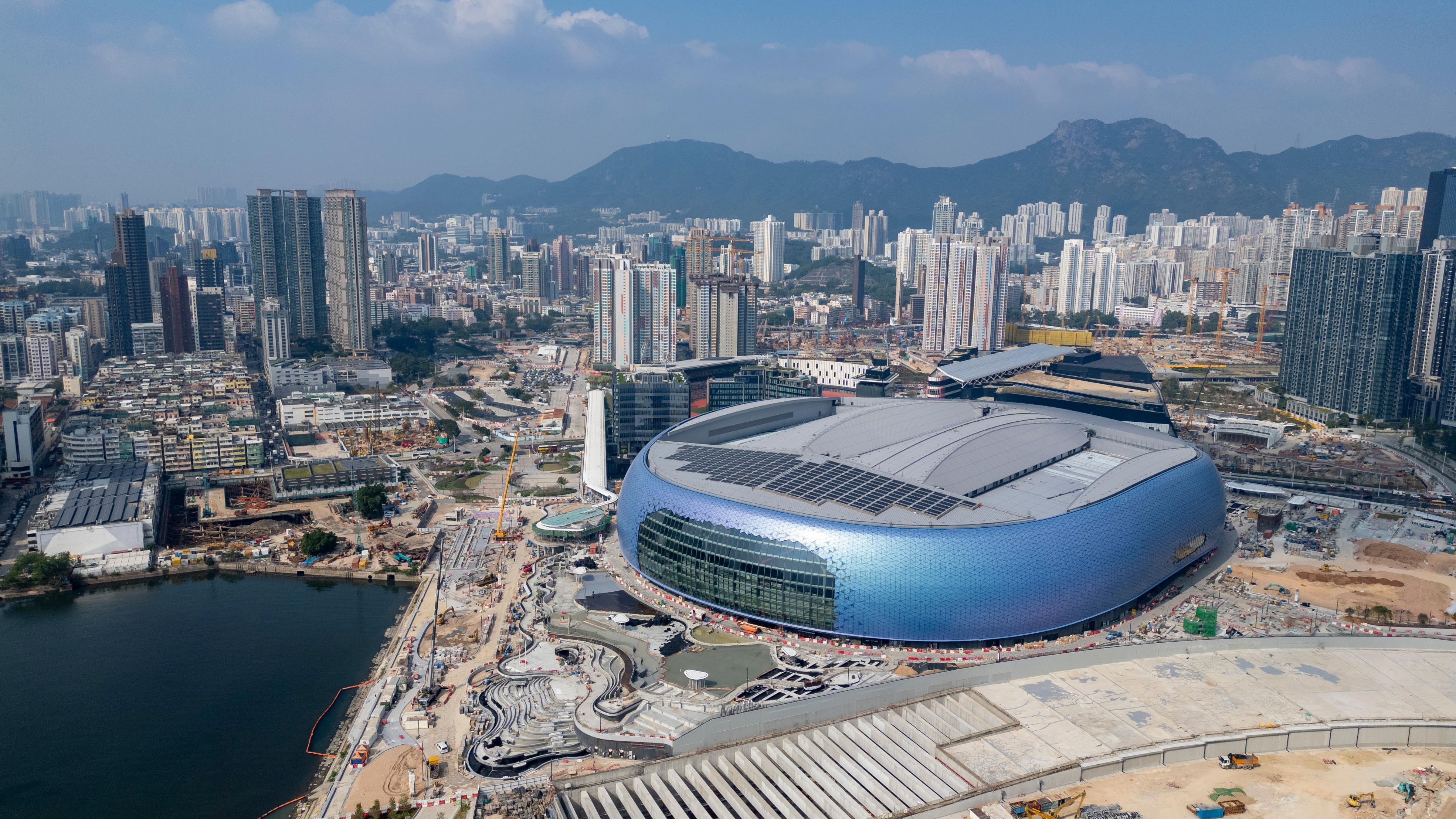
A 50,000-seat Main Stadium in Hong Kong's new sports precinct. Envelope and roof geometry development, computational design leadership, and façade coordination across concept through construction documentation.
A stronger form.
A leaner envelope.
From 47,000 panels
to 27,000.
By adjusting the parametric model in real time, the team could instantly visualise the impact of every geometric decision — enabling the architecture team to review options live and the client to validate them on the spot. A fast, evidence-based decision process that compressed weeks of back-and-forth into focused review sessions.
aesthetics and retractable roof fall.
From setout
to geometry.
With the roof tangent established, the facade rationalisation moves through constant-diameter and constant-length arcs — tying structural grid, cladding system, and substructure into a single coherent logic.
aligned with our facade setout geometry.
Geometry development
and coordination.
The Kai Tak Sports Park Main Stadium presented one of the most geometrically complex envelope challenges in recent Hong Kong architecture. The elliptical roof form, combined with a retractable panel system, required careful computational development to translate design intent into buildable geometry.
Involvement spanned envelope and roof geometry development, façade system coordination, and computational design leadership from concept through construction documentation — as part of the Populous project team.
Parametric modelling was used to test rationalisation strategies across the double-curvature surfaces, optimise panel layouts for fabrication efficiency, and coordinate interface conditions between the roof structure, façade system, and building services.
This project was delivered as part of Brice Pannetier's role while employed at Populous, with Populous acting as the appointed architectural practice. The 3D model and animation shown above were produced independently by Atelier Designa for illustrative purposes. Architectural services provided by Populous.